

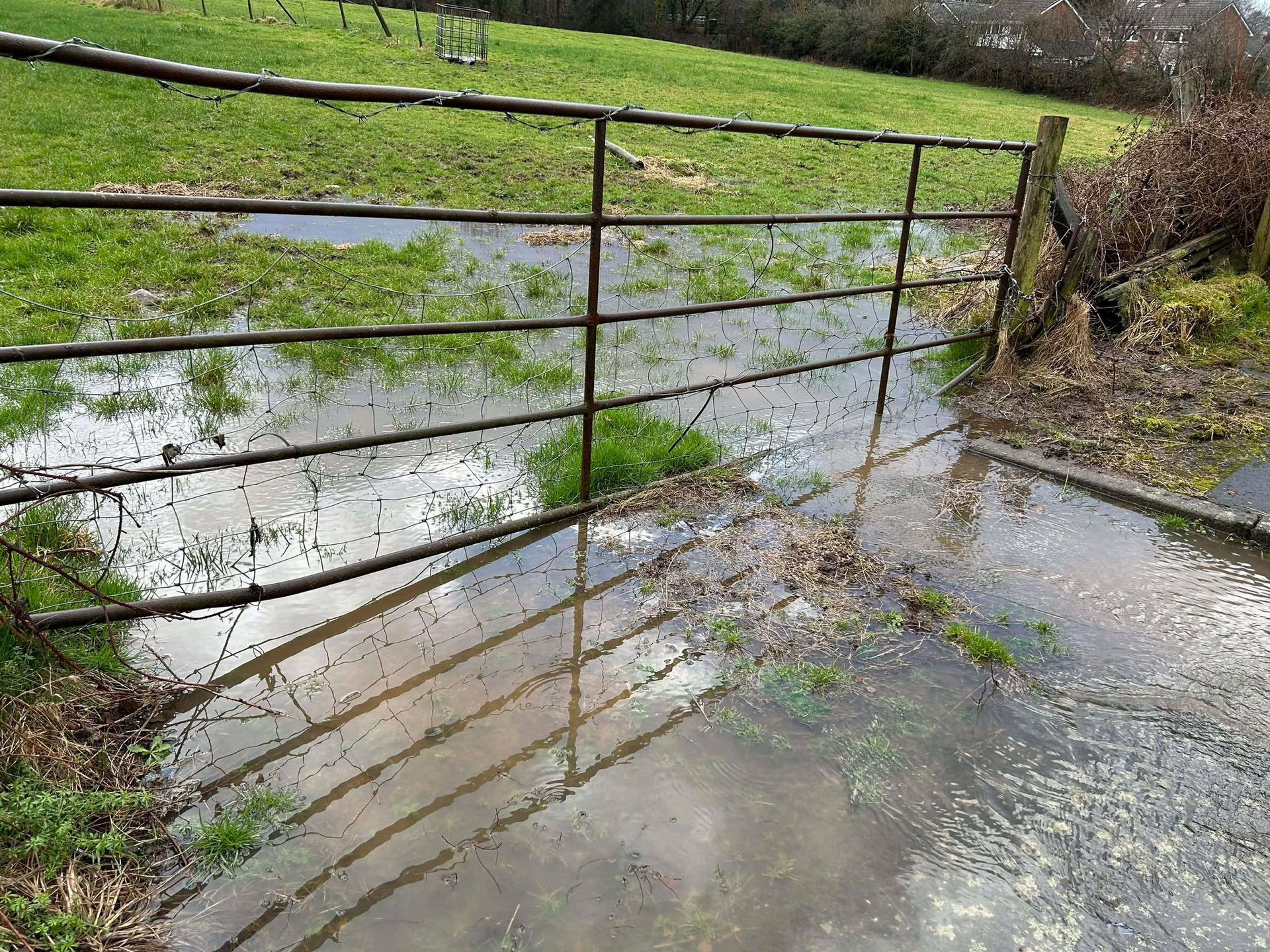
Over recent weeks, heavy and persistent rainfall has laid bare what many local residents have known for years: the land around Sandown Fields is not suitable for housing development. The flooding we have witnessed across our streets and gardens is a stark demonstration of just how much water this area has to cope with, and Sandown Fields is currently doing a lot of the vital work of absorbing it. Build on that land, remove that natural buffer, and all of that water has nowhere to go. The consequences for our community would be severe and lasting.
What residents are already experiencing
On Sandown Road and across the surrounding area, residents have been reporting a phenomenon known as "pooling" - pools of standing water appearing not just on the open fields, but in private gardens too. This is not surface run-off from a blocked drain. It is groundwater flooding: water that has saturated the soil and is rising up through the ground itself. Groundwater flooding occurs where heavy and sustained rainfall has disrupted the natural water table, forcing water upward through the ground. Unlike surface flooding, it cannot simply be redirected by a drain. It affects homes, foundations, and gardens in ways that are difficult and expensive to reverse.
Meanwhile, on the wider Racecourse Estate, the heavy rain and cold temperatures have worsened existing pothole damage on the roads within the estate, residents with a sharp eye will have noticed that the road surface on Highfield Road has dropped slightly in recent times. This kind of ground movement is a red flag, suggesting the subsurface is already under stress from water saturation.
Sandown Fields is already classified as high flood risk
This is not a matter of opinion. Sandown Fields carries an official designation as a High Flood Risk area. That designation exists because the land performs a vital hydrological function: it absorbs and manages water that would otherwise flood our streets, gardens and homes. Sandown Fields is already working as a flood defence, quietly, naturally and without any cost to the taxpayer. Allow housing to be built there, and that defence is gone. The water will still arrive, possibly even more if other developments further upstream are permitted, and it will simply have nowhere to go.
This is not a matter of opinion. Sandown Fields carries an official designation as a High Flood Risk area. That designation exists because the land performs a vital hydrological function: it absorbs and manages water that would otherwise flood our streets, gardens and homes. Sandown Fields is already working as a flood defence, quietly, naturally, and without any cost to the taxpayer. Allow housing to be built there, and that defence is gone. The water will still arrive, possibly even more if other developments further upstream are permitted, and it will simply have nowhere to go.
The insurance question every buyer must ask
Many people are unaware of a government and insurance industry scheme called Flood RE, designed to help homeowners in flood-prone areas obtain affordable insurance. Here is the critical point: any home built after 1 January 2009 is automatically excluded from Flood RE. This was a deliberate policy decision - the government does not sanction building on flood plains, and the exclusion exists specifically to avoid incentivising developers to do so.
In plain terms: any new homes built on Sandown Fields would have no access to Flood RE. Buyers could find that flood insurance is extremely expensive or simply unavailable to them. This is not a remote risk, it is a known and documented consequence of building on flood-risk land, and one that developers are unlikely to advertise at the point of sale and buyers would not discover until it was too late.
Green land is infrastructure
There is a tendency in planning debates, especially with the current government, to frame open green space as a luxury, nice to have, but expendable when (unobtainable) housing targets must be met. The flooding we are currently experiencing gives the lie to that framing entirely. Green, permeable land manages water, supports biodiversity and regulates the local environment in ways that no engineered drainage solution can fully replicate. What we are seeing on our streets and in our gardens right now is what happens when that natural infrastructure is stressed by extreme weather and compromised by other developments that are eroding green belt land in the local vicinity. Imagine the same rainfall landing on tarmac, rooftops and compacted ground where Sandown Fields currently stands… the flooding would be significantly worse, and it would be permanent.
Our call to action
HGGAG urges every resident who has experienced pooling, waterlogged gardens or road damage during periods of heavy rainfall to document and report it. Photographs, dates and written accounts all constitute valuable evidence in the planning process. We will continue to collate this evidence and present it to the relevant planning authorities as part of our ongoing case against development at Sandown Fields.
The rain has made the argument for us. Now we must make sure decision-makers hear it.
 If you have experienced flooding, pooling, or ground movement near Sandown Road, the Racecourse Estate, Torkington Road, Torkington Lane, Offerton Lane or Highfield Road, please get in touch via hggag.co.uk. Your evidence matters.